TL;DR: Resumes Coach used to do one thing well — score a resume against a job description and help you fix it. It now does the whole loop: a rebuilt three-part resume score, a career profile that carries your context into every rewrite, a full application tracker from saved to offer, a per-job fit score, and a bookmarklet that captures a posting in one click. This post walks through what each piece does and why it matters.
For most of its life, Resumes Coach was a sharp tool with a narrow job. You pasted a job description, uploaded a resume, and got a score plus specific fixes. That worked. But it treated every session like the first one — it never remembered who you were, and it stopped caring the moment you closed the tab.
The job search isn’t one session. It’s dozens of applications over weeks, each one a small project, and the parts that decide the outcome happen between the sessions — which roles you chase, how you position the same history for different targets, what you do after you hit submit.
So we rebuilt around the whole loop, not the single moment. Here’s what’s new.
A Resume Score That Tells You Where It’s Weak
The old score gave you one number. A number tells you something’s wrong but not what to do about it.
The new Resumes Coach Score (RCS) breaks into three parts, because “your resume is a 71” and “your resume is a 71 because the writing is strong but the positioning is off for this role” lead to completely different next moves.
- Content — are your bullets quantified, specific, action-led? Is the writing doing work, or is it filler?
- Structure — can a machine and a human both parse it fast? Completeness, formatting, length, the things that survive the six-second scan.
- Positioning — does this resume actually argue for this role, against this job description?
Content and structure are about the resume in isolation. Positioning is about the match. Splitting them means you stop guessing. A high-content, low-positioning resume doesn’t need rewriting — it needs re-aiming. The RCS now tells you which.
One number tells you to panic. Three numbers tell you what to fix.
A note on what this is and isn’t: the RCS is our read on resume quality and job-description fit. It is not the score some company’s applicant tracking system will spit out — nobody outside those companies can see those. It’s the most honest version of “how strong is this, and where” that we can give you before you hit apply.
A Career Profile That Remembers Who You Are
This is the change that quietly improves everything else.
You now have a career profile — your level, your function, your years in, the industries you’ve worked in, and the direction you’re heading. You fill it once. From then on, every resume tailoring, every cover letter, and every job-description analysis starts from your context instead of a blank slate.
Why this matters: the same fifteen years of experience should be framed differently when you’re going for a senior IC role versus a first management role. Before, you had to re-explain that intent every time. Now the profile carries it. You can even keep more than one target path — say, a “stay technical” track and a “move into management” track — and tailor against whichever one a given job calls for.
The hard rule we hold here: we reframe, we never invent. The profile lets us emphasize the parts of your real history that fit the target. It does not make up titles, metrics, or experience you don’t have. (Why that line matters more than ever.)
An Application Tracker, Built In
A spreadsheet is where job-search momentum goes to die. You start one, you stop updating it by week two, and then you’re applying to a role you already applied to in March.
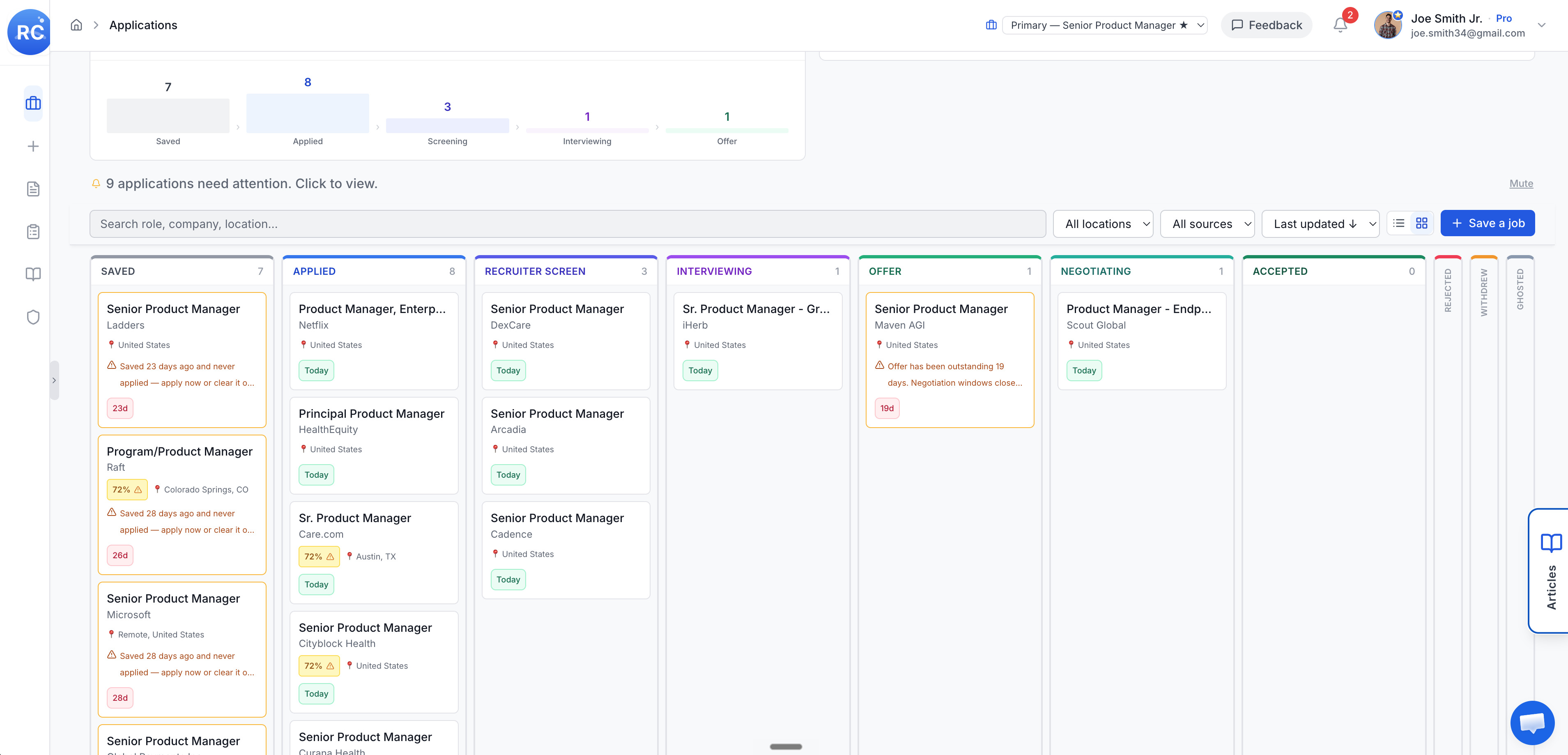
Resumes Coach now has a real application tracker. Every job moves through a pipeline — saved, applied, screening, interviewing, offer, and the outcomes after — on a board you can actually see. Each application keeps its own timeline (when you applied, when the recruiter replied, every interview round), its contacts, and the resume you sent.
Two things make it more than a prettier spreadsheet:
- Analytics that mean something. Once you’ve got a handful of applications in, you see your real numbers — how many are active, what’s gone stale, your offer rate. Job search runs on dread because it feels like shouting into a void. Numbers turn it back into a process you can adjust.
- Follow-up nudges. The tracker knows when an application has gone quiet past the point where a nudge helps, and tells you. Following up is one of the highest-leverage things you can do, and it’s exactly the thing everyone forgets.
A Fit Score for Every Application
The RCS positioning score tells you how well a resume argues for a role. The new job-match score goes one level finer: for any application you’re tracking, you get a fast, JD-specific read on how well your resume and that exact posting line up — plus the specific gaps.
It’s separate from your overall resume score on purpose. A resume can be excellent in general and a weak match for one particular job. That’s not a flaw in the resume; it’s information about where to spend your tailoring time. The match score makes that call for you, application by application.
Capture a Job in One Click
The most annoying part of tracking applications is the data entry — copying the title, the company, the description, the link, into yet another form.
The new bookmarklet kills that. You’re on a job posting anywhere — LinkedIn, a company careers page, wherever — you click it once, and the job lands in your tracker with everything filled in. From there you tailor, score, and apply without re-typing a thing.
What To Do Next
If you’ve used Resumes Coach before, the fastest way to feel the difference:
- Fill in your career profile. It takes two minutes and it’s what makes every tailoring smarter. We’ll prompt you for it next time you’re in.
- Save a job to the tracker — paste one in, or grab the bookmarklet and capture one in a click.
- Run the analysis and read the three-part score, not just the number. The positioning line is where most of the leverage is.
The old Resumes Coach helped you fix one resume. The new one helps you run a job search. That’s the whole point of the upgrade.
Everything above is live now. Open Resumes Coach → — fill in your profile, capture your first job, and see the new score.